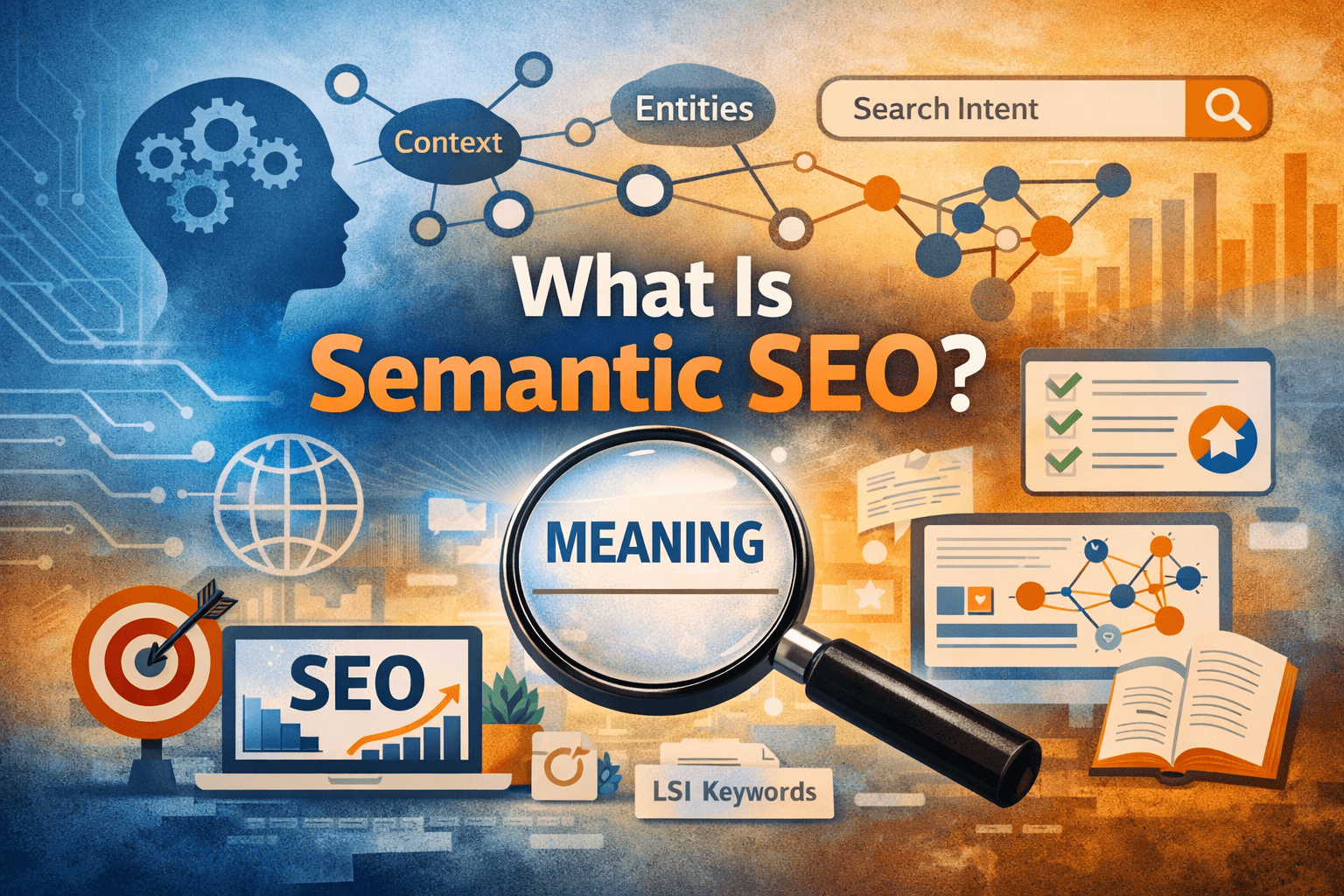
Semantic SEO is the practice of optimizing content around meaning, context, and user intent rather than relying only on exact‑match keywords. Instead of asking, “How many times did I use a keyword?”, semantic SEO asks, “Did I fully answer what the searcher is trying to understand?”
Modern search engines like Google no longer rank pages just by matching words. They analyze relationships between topics, entities, and concepts to decide which content best satisfies a query. Semantic SEO aligns your content with how search engines actually interpret language.
This approach improves rankings, increases topical authority, and makes your content more resilient to algorithm updates.
Why Semantic SEO Matters in 2026
Search behavior has changed. Users now search with natural language queries, voice assistants, and long‑form questions. Google responds using semantic understanding through systems like Knowledge Graph, BERT, and MUM.
If your content is still built only around exact keywords, it may:
- Rank for fewer variations
- Miss featured snippets
- Struggle against high‑authority competitors
Semantic SEO helps your content:
- Rank for multiple related queries
- Match search intent more accurately
- Perform better in AI‑driven search results
What Is Semantic Search SEO?
Semantic search SEO refers to how search engines interpret the meaning behind a query rather than the literal words used.
For example:
- Query: “best CRM for ecommerce”
- Google understands related concepts like customer data, integrations, automation, and online stores even if those exact words are not used in the query.
Semantic search considers:
- User intent
- Query context
- Synonyms and variations
- Related entities
- Past search behavior
Semantic SEO ensures your content aligns with these signals.
What Is Semantic SEO Strategy?
A semantic SEO strategy focuses on covering a topic completely instead of targeting a single keyword.
Core elements include:
- Topic clustering
- Entity optimization
- Search intent mapping
- Semantic keywords and variations
- Structured content
Rather than publishing multiple thin pages, semantic SEO favors one authoritative resource that answers all related questions around a topic.
What Is Semantic Keywords in SEO?
Semantic keywords are words and phrases that are conceptually related to your main keyword. They help search engines understand context.
For the keyword “what is semantic SEO”, semantic keywords include:
- semantic search
- search intent
- entities
- topical relevance
- content depth
These keywords do not need exact repetition. Their purpose is to reinforce meaning, not manipulate rankings.
What Is Latent Semantic Indexing in SEO?
Latent Semantic Indexing (LSI) is a mathematical model originally developed to identify relationships between words and documents.
In SEO, LSI is often misunderstood.
What Is Latent Semantic Indexing LSI in SEO (Reality Check)
While Google does not use classic LSI technology, the concept is still useful:
- Search engines analyze relationships between terms
- Context matters more than repetition
- Related terms help clarify meaning
So when people ask “what is latent semantic indexing in SEO”, they usually mean using related terms that naturally support a topic.
What Is SEO Semantic Coding?
SEO semantic coding refers to using clean, meaningful HTML structure so search engines understand your content hierarchy.
Examples include:
- Proper heading order (H1 → H2 → H3)
- Semantic HTML elements like , ,
- Clear internal linking
- Descriptive anchor text
Semantic coding improves:
- Crawlability
- Accessibility
- Content comprehension
It supports semantic SEO by clarifying relationships between content sections.
Semantic Content: What Makes Content Truly Semantic?
Semantic content goes beyond surface‑level explanations.
It:
- Answers primary and secondary questions
- Covers definitions, examples, and use cases
- Uses natural language
- Matches user intent at each stage
Semantic content does not stuff keywords. It explains ideas clearly and logically.
How Search Engines Understand Semantic SEO
Search engines evaluate semantic relevance using:
- Entities (people, brands, concepts)
- Relationships between entities
- Co‑occurring terms
- Topical depth
If your page connects these elements clearly, it becomes easier for Google to trust and rank it.
Sémantique SEO: Global Perspective
The concept of sémantique SEO (commonly used in French SEO communities) emphasizes the same principle: optimizing content around meaning and context.
Across languages and markets, semantic SEO is now a core ranking factor for competitive keywords.
How to Implement Semantic SEO (Step‑by‑Step)
1. Start With Search Intent
Identify whether the query is:
- Informational
- Navigational
- Commercial
- Transactional
Your content must match the dominant intent.
2. Build Topic Clusters
Create a main pillar page supported by related subtopics.
3. Use Semantic Keywords Naturally
Include related terms where they add clarity not force.
4. Optimize Internal Linking
Link related content logically to reinforce topical authority.
5. Improve Content Structure
Use clear headings, bullet points, and logical flow.
Common Semantic SEO Mistakes
- Overusing keywords instead of explaining concepts
- Creating multiple pages for the same intent
- Ignoring related questions users ask
- Writing for algorithms instead of humans
Semantic SEO rewards clarity, not tricks.
Semantic SEO vs Traditional SEO
| Traditional SEO | Semantic SEO |
|---|---|
| Keyword‑focused | Topic‑focused |
| Exact match terms | Context & meaning |
| Isolated pages | Connected content |
| Short‑term wins | Long‑term authority |
Final Thoughts - What is SEO Semantic Coding
Understanding what is semantic SEO is no longer optional, it is foundational.
Search engines reward content that explains, connects, and educates. By focusing on semantic SEO, you create content that ranks for more queries, survives algorithm changes, and delivers real value to users.
For businesses building long‑term organic growth, semantic SEO is not a trend. It is the future.
What is Semantic Search SEO - FAQs
What is a semantic SEO example in 2026?
Semantic SEO example is creating one in-depth page on “CRM for eCommerce” that explains use cases, integrations, customer data, and automation instead of repeating the keyword.
What is the difference between SEO and semantic SEO for Startups?
Semantic SEO focuses on meaning, context, and user intent so content ranks for many related searches, not just one term.
What are the 4 types of SEO for local businesses?
Four types of SEO are on-page SEO, off-page SEO, technical SEO, and local SEO. Each type targets a different ranking factor, from content and links to site structure and geographic relevance.