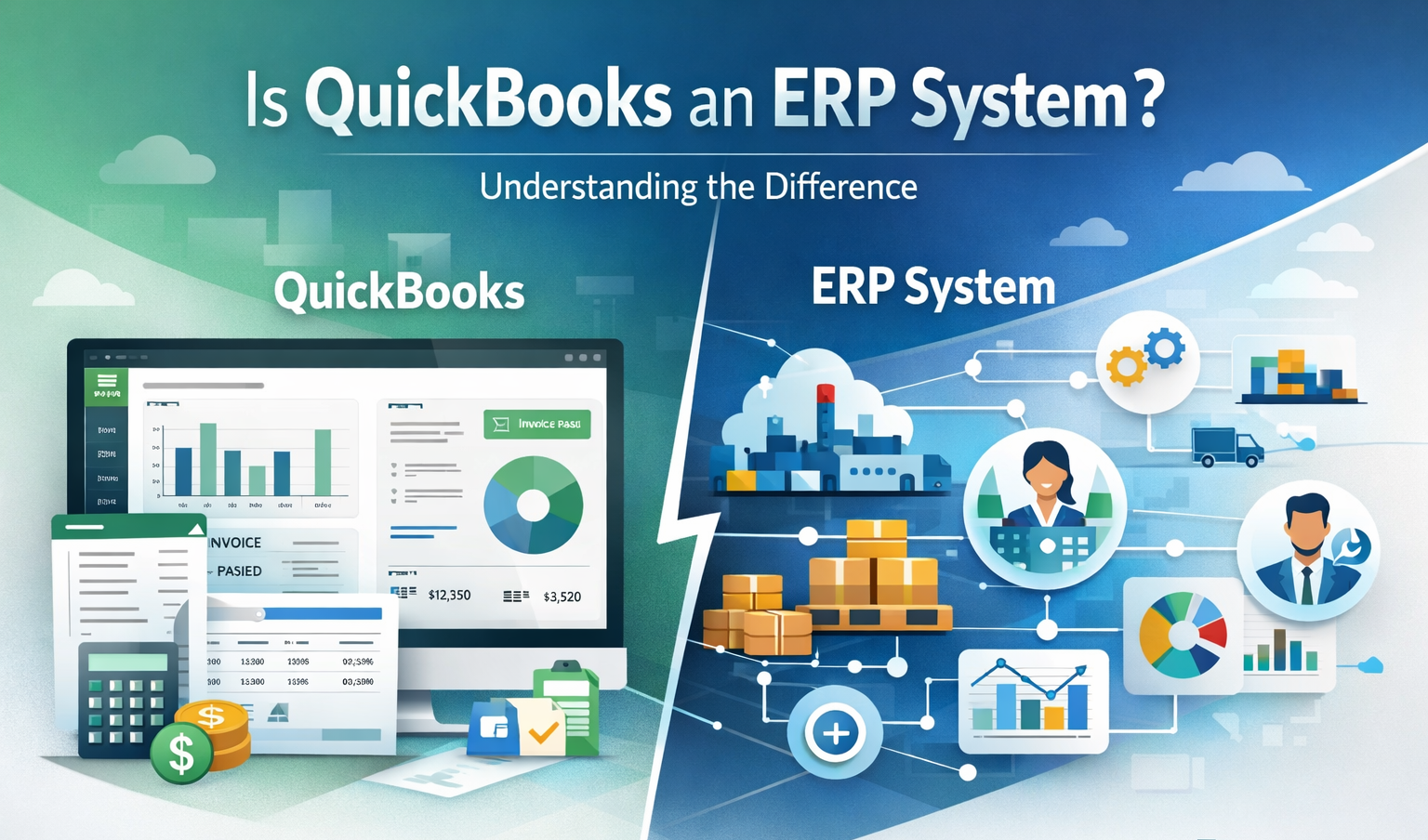
No. QuickBooks is accounting software, not a full ERP platform. It manages financial transactions, while ERP systems unify finance, operations, inventory, procurement, CRM, and reporting in one environment.
Businesses often ask is quickbooks an erp system when growth introduces operational complexity. This guide explains the differences, where QuickBooks fits, and when an ERP becomes necessary.
QuickBooks vs ERP
QuickBooks
-
Designed for accounting and financial management
-
Handles invoicing, expenses, payroll, and tax reporting
-
Suitable for small businesses and early-stage growth
-
Requires add-ons for operational workflows
ERP Systems
-
Integrate finance, operations, supply chain, CRM, and reporting
-
Provide real-time operational visibility
-
Automate cross-functional processes
-
Support scaling organizations and complex workflows
Bottom line: QuickBooks manages finances. ERP systems manage the entire business.
What an ERP System Does
ERP (Enterprise Resource Planning) software connects core business functions into one centralized platform.
Core ERP Capabilites
-
Financial management & compliance
-
Inventory & supply chain control
-
Procurement & vendor workflows
-
Manufacturing & production planning
-
Customer lifecycle & CRM integration
-
Project & resource management
-
Business intelligence & forecasting
ERP creates a single source of truth for decision-makers.
What QuickBooks Does Well
QuickBooks remains popular because it simplifies financial management.
Key Strengths
- Bookkeeping & general ledger
- Invoicing & billing
- Expense & cash flow tracking
- Payroll & tax compliance
- Financial reporting
- Bank reconciliation
For startups and small businesses, it delivers financial clarity without complexity.
Is QuickBooks Considered an ERP System?
QuickBooks is sometimes described as a “light ERP,” but this is inaccurate.
While it manages financial data, it does not integrate operations across departments. ERP platforms unify workflows, while QuickBooks focuses on accounting.
QuickBooks = financial management
ERP = enterprise-wide operational control
Is QuickBooks Online an ERP System?
QuickBooks Online is cloud-based accounting software.
Improvements in the Online Version
-
Remote access and collaboration
-
Automated bank feeds
-
Integration with third-party apps
-
Multi-user access
Despite these advantages, it remains accounting software, not ERP.
Is QuickBooks Enterprise an ERP System?
QuickBooks Enterprise offers enhanced capabilities compared to standard versions:
-
Advanced inventory tracking
-
Industry-specific editions
-
Expanded reporting tools
-
Higher user capacity
However, QuickBooks Enterprise is not a full ERP system. It strengthens financial and inventory functions but lacks full operational integration.
When QuickBooks Is Enough
QuickBooks is ideal if your business:
- Has simple operations
- Does not manage complex inventory
- Needs straightforward financial tracking
- Uses limited integrations
- Is in early growth stages
Signs You’ve Outgrown QuickBooks
Organizations often explore ERP when:
-
Manual spreadsheets increase
-
Inventory errors or stock issues occur
-
Multiple systems create data silos
-
Financial reporting is slow or inconsistent
-
Forecasting lacks accuracy
-
Operations scale faster than systems
These challenges signal the need for integrated operations.
ERP Benefits for Growing Companies
Unified Visibility
Centralized data improves decision-making.
Workflow Automation
Reduces manual processes and operational delays.
Accurate Forecasting
Real-time insights improve planning and budgeting.
Operational Efficiency
Aligns departments and streamlines processes.
Growth Readiness
Supports expansion without system fragmentation.
Can QuickBooks Be Part of an ERP Strategy?
Yes. Many companies use QuickBooks during early growth and later integrate or migrate.
Common Approaches
Integration Approach
QuickBooks connects with CRM, inventory, and operations tools.
Hybrid Approach
QuickBooks handles finance while ERP manages operations.
Migration Approach
Businesses transition fully to ERP as complexity increases.
Ohadtech helps companies evaluate the best path based on growth trajectory and operational needs.
ERP Alternatives Businesses Evaluate
Companies moving beyond QuickBooks commonly consider:
-
NetSuite
-
Microsoft Dynamics 365
-
Acumatica
-
SAP Business One
-
Odoo
The right solution depends on industry complexity, reporting needs, and scalability goals.
FAQ
Is QuickBooks an ERP system?
No. QuickBooks is accounting software, while ERP systems integrate finance, operations, and business workflows.
Is QuickBooks considered an ERP system?
No. It manages financial data but does not provide enterprise-wide operational integration.
Is QuickBooks Online an ERP system?
No. It is cloud-based accounting software with integrations but not a complete ERP platform.
Is QuickBooks Enterprise an ERP system?
No. It includes advanced features but lacks full ERP capabilities.
When should a business move from QuickBooks to ERP?
When operational complexity increases, manual work grows, and unified reporting becomes necessary.
The Right System for Your Growth Stage
QuickBooks is an excellent financial foundation. However, when operations become complex, businesses need integrated systems that unify workflows and data.
Ohadtech helps organizations evaluate system readiness, integrate tools, and implement ERP platforms that support sustainable growth.
Schedule a consultation to assess your ERP readiness.
Relevant Guides & Services
What to Look for When Hiring a Web Developer
Back End Web Development Services